
Workshop on Symbolic Regression and Equation Discovery
Part of the 2026 IEEE World Congress on Computational Intelligence (WCCI) and the IEEE Congress on Evolutionary Computation (CEC)
June 21st - 26th, 2026
Maastricht, Netherlands
We call for submissions of research papers of maximally 6 pages. Submissions must adhere to the WCCI/CEC submission rules and guidelines to authors. We follow double blind review process, therefore each paper submitted for the review should be anonymized. See instructions below. Accepted papers must presented by at least one author at the required time slots of approximately 20 minutes at the conference. Presenters have to register for the conference.
Submission Deadline April 24th Extended: May 8th, 2026 23:59 (anywhere on Earth) via openreview
Additional Information on WCCI / CEC:
https://attend.ieee.org/wcci-2026/
https://attend.ieee.org/wcci-2026/ieee-cec-2025/
Important note:
For the first time, we will use openreview.net for submissions and review this year.
The papers are only published on openreview.net (not in the WCCI/CEC proceedings).
Program
The workshop is scheduled for Monday 22nd June, 2026, Room: 2.18 Mekong- 11:30: Welcome and Introduction, Gabriel Kronberger
- 11:40: Invited Talk: "Exhaustive Symbolic Regression: Learning Physics directly from Data", Harry Desmond
- 12:30: "Learning Parametric Nitrogen Fertilizer Response Curves Using Neuro Symbolic Regression", Giorgio Morales, John Sheppard
- 13:00: "SRToolkit: Shared Infrastructure for Symbolic Regression Research", Sebastian Mežnar, Ljupco Todorovski, Sašo Džeroski
- 13:30: Lunch Break
- 14:30: Invited Talk: "Evolution of mutation + Genetic and agentic symbolic regression of distributed rate-and-state friction models", Marco Virgolin
- 15:20: "Prediction Intervals and Confidence Regions for Symbolic Regression Models based on Likelihood Profiles", Fabricio Olivetti de Franca, Gabriel Kronberger
- 15:50: "Generalized Residuals Symbolic Regression", Rory Sweeney, Takfarinas Saber, James McDermott
- 16:20: Closing Remarks
Scope
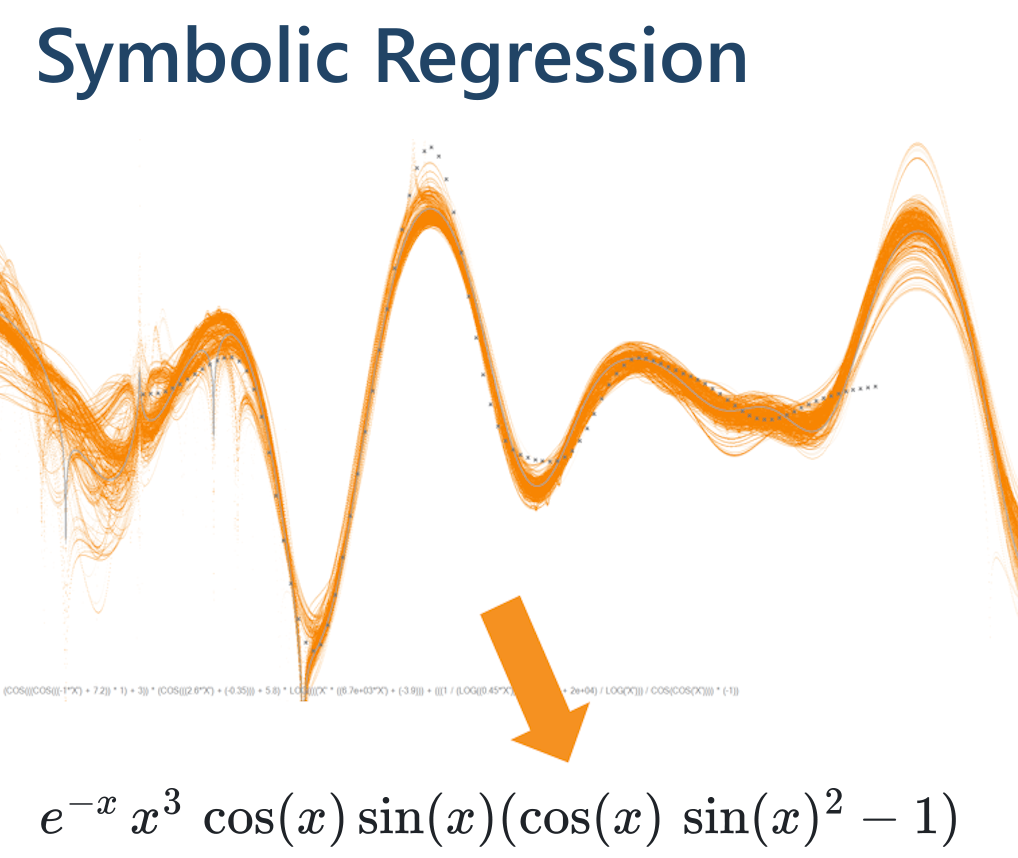
Symbolic regression (SR) is a form of automated equation discovery from data using computational intelligence techniques. SR was first introduced by John Koza as a specific task that can be approached using genetic programming, and as such is tightly connected to evolutionary algorithms. However, equation discovery from data has been a goal of artificial intelligence (AI) research since its early beginnings. In recent years, several novel techniques have emerged, most notably methods based on deep (reinforcement) learning and large language models (LLMs). Especially with the focus on interpretability and explainability in AI research, SR takes a leading role among machine learning methods, whenever model inspection and understanding is desired.
The focus of this workshop is to further advance the state-of-the-art in SR and more general equation discovery, by gathering experts in the field, and facilitating an exchange of research ideas. We encourage submissions presenting novel techniques or applications of SR, theoretical work, or algorithmic improvements to make SR methods more efficient, more reliable, and generally better controlled.
Particular topics of interest include, but are not limited to:
- Evolutionary and non-evolutionary algorithms for symbolic regression
- Dealing with uncertainty and model selection
- Knowledge integration (physical laws, constraints, ...)
- Neuro-symbolic learning and large language models for equation learning
- Benchmarking symbolic regression algorithms
- Symbolic regression applications
Important Dates
- Submission deadline:
April 24th, 2026May 8th, 2026 via the OpenReview workshop page - Notification of acceptance: End of May, 2026
- Conference workshop: June 22nd, 2026, Maastricht
Previous Workshops
2025 in Malaga (GECCO)
- SCRBenchmark: A Benchmarking Library for Shape-Constrained Regression, Bachinger, Werth, Zenisek, Haider, Olivetti de Franca
- Continuous Pruning for Symbolic Regression, Werth, Affenzeller
- When Data Transformations Mislead Symbolic Regression: Deceptive Search Spaces in System Identification, Tonda, Zhang, Chen, Xue, Zhang, Lutton
- Call for Action: towards the next generation of symbolic regression benchmark, Imai Aldeia, Zhang, Bomarito, Cranmer, Fonseca, Burlacu, La Cava, de França
- Rewarding Model Smoothness and Simplicity via Alternating Objectives in Symbolic Regression, Haut, Kotanchek
- Model Recovery in Symbolic Regression: Theory, Conjectures, and Open Questions, Senn
- A Hierarchical Multiview Symbolic Regression Method for Decoding Oceanic Metabolism, Lira, Martí, Sanchez-Pi
- On the use of Hinge Loss as a Surrogate Fitness Function with Grammatical Evolution for Parkinson’s Disease Classification, Duan, Nicolau, O'Neill
- Can Synthetic Data Improve Symbolic Regression Extrapolation Performance?, Ramlan, O'Riordan, Kronberger, McDermott
2024 in Melbourne (GECCO)
- Deep Symbolic Optimization for Combinatorial Optimization: Accelerating Node Selection by Discovering Potential Heuristics, H. Liu, H. Lui, Y. Kuang, J. Wang, B. Li
- Interactive Symbolic Regression - A Study on Noise Sensitivity and Extrapolation Accuracy, S. Raghav, T. Kumar, R. Balaji, M. Sanjay, C. Shunmuga
- Comparing Methods for Estimating Marginal Likelihood in Symbolic Regression, P. Leser, G. Bomarito, G. Kronberger, F. Olivetti de Franca
- Accelerating GP Genome Evaluation Through Real Compilation with a Multiple Program Single Data Approach, V.V. de Melo, W. Banzhaf, G. Iacca
- Characterising the Double Descent of Symbolic Regression, G. Dick, C. Owen
2023 in Lisbon (GECCO)
- Priors for Symbolic Regression, Deaglan Bartlett, Harry Desmond, Pedro Ferreira
- Evolving Deformable Mirror Control to Generate Partially Coherent Light Fields, Daniel Younis, Thomas M. Antonsen, Luke A. Johnson, Eric O. Scott, Dimitri Kaganovich, Baham Hafizi
- Towards Vertical Privacy-Preserving Symbolic Regression via Secure Multiparty Computation, Du Nguyen Duy, Michael Affenzeller, Ramin Nikzad-Langerodi
- GECCO'2022 Symbolic Regression Competition: Post-Analysis of the Operon Framework, Bogdan Burlacu
2022 in Boston (GECCO)
- Uncertainty in Equation Learning, Matthias Werner, Andrej Junginger, Philipp Henning, Georg Martius
- Bingo: A Customizable Framework for Symbolic Regression with Genetic Programming, David Randall, Tyler Townsend, Jacob Hochhalter, Geoffrey Bomarito
- Interaction-Transformation Evolutionary Algorithm with Coefficients Optimization, Guilherme Imai Aldeia, Fabricio de Franca
- Coefficient Mutation in the Gene-pool Optimal Mixing Evolutionary Algorithm for Symbolic Regression, Marco Virgolin, Peter Bosman
- Genetic Programming with Stochastic Gradient Descent Revisited: Initial Findings on SRBench, Grant Dick
- Invited Talk From the Winner of the Symbolic Regression Competition
Organizing Committee
Gabriel Kronberger - University of Applied Sciences Upper Austria gabriel.kronberger@fh-hagenberg.at
Fabricio Olivetti de França - Universidade Federal do ABC
William La Cava - Boston Children’s Hospital and Harvard Medical School
Steven Gustafson - University of Washington




Previous Editions
SymReg Workshop @ GECCO 2025SymReg Workshop @ GECCO 2024
SymReg Workshop @ GECCO 2023
SymReg Workshop @ GECCO 2022